
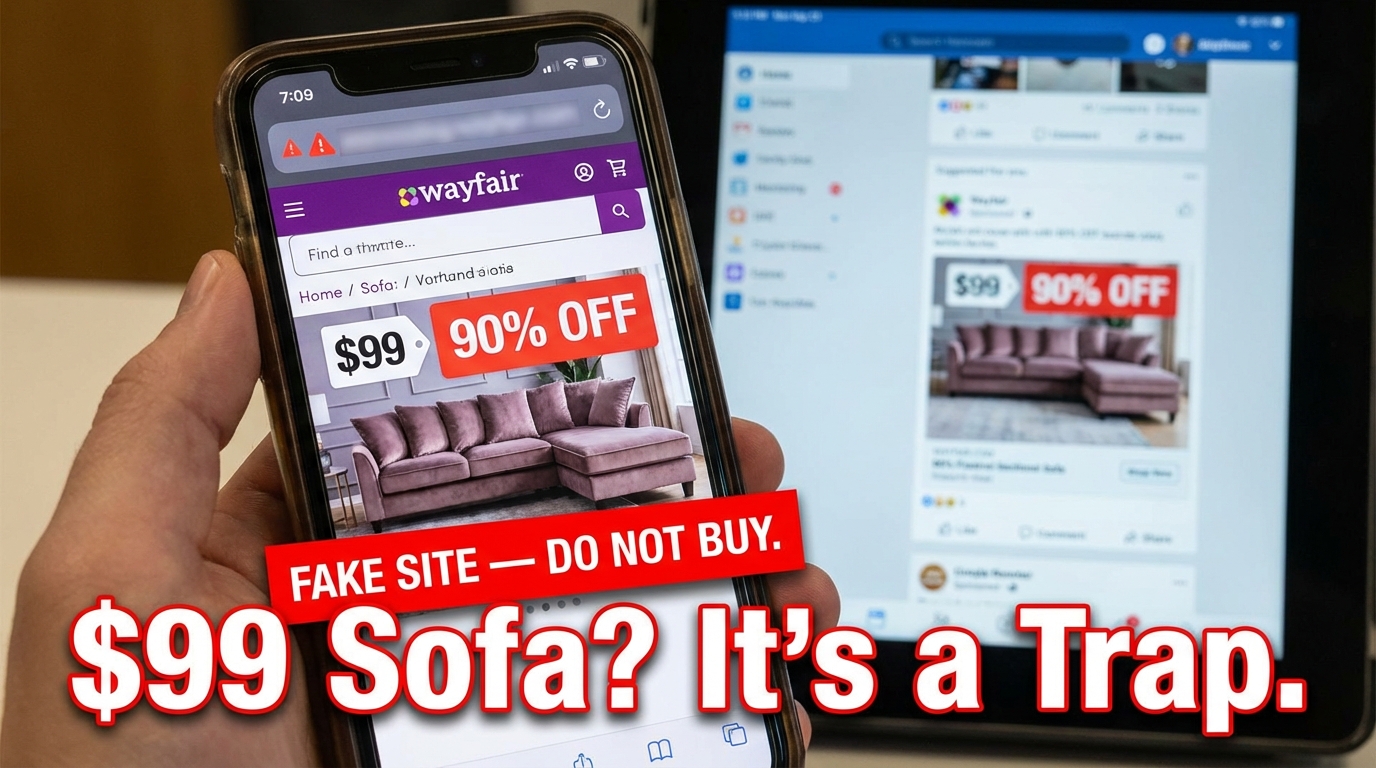
Wayfair Scam Alert: Fake Deals, 90% Off Traps & How to Stay Safe

Wayfair Scams Are Costing Shoppers Real Money — Here's What You Need to Know
Wayfair scam operations have exploded in recent years, and if you've landed here, there's a good chance something already felt off about a deal you saw online.
Here's the quick answer most people need:
Is the Wayfair deal you saw a scam? Check these fast:
- URL: Only
wayfair.comis real. Sites likewaydayhotsale.shop,buywayfair.com, orwayfair-us.topare fakes. - Discount: 90% off furniture is not real. Scam sites advertise sofas for $99 and coffee tables for $39.
- What happens: You pay, get nothing (or a cheap knockoff), and the site disappears.
- What to do right now: Contact your bank or PayPal immediately and dispute the charge.
Wayfair is one of the biggest online furniture retailers in the US, which makes it a prime target for impersonators. Scammers build near-identical fake storefronts, run paid ads on Facebook, Instagram, and TikTok, and lure shoppers in with jaw-dropping discounts — then vanish after collecting payment.
Real victims have reported losses ranging from $50 to over $90 on sites designed to look exactly like the real thing. One BBB Scam Tracker report described a shopper who noticed something was wrong only after calling the real Wayfair and learning no order existed.
The fake sites are convincing. They copy Wayfair's logo, product photos, and page layout down to the smallest detail. And they often show a padlock icon in the browser bar — which many people mistakenly trust as a sign of safety.
The threat is real, it's growing, and it specifically targets people who shop online for deals.
This guide covers every angle: how these scams work, how to spot them, and exactly what to do if you've already been hit.

Why Wayfair is a Target for Scammers
It isn't just bad luck that makes Wayfair a frequent face for online fraud. Several structural factors make it the perfect "skin" for a scammer to wear. According to research on Unveiling Wayfair Scams: A Guide To Safe Shopping, the company’s business model and massive market presence create a unique set of vulnerabilities.
- The Drop-Shipping Model: Wayfair doesn't manufacture most of what it sells. It acts as a massive middleman for thousands of third-party suppliers. This creates a "marketplace" feel that scammers exploit by pretending to be just another outlet or a "clearance" arm of the brand.
- High Transaction Volume: With millions of orders processed monthly, a few thousand fraudulent ads can easily blend into the digital noise.
- Brand Recognition: Wayfair is a household name. We tend to lower our guard when we see a familiar logo, especially when it’s attached to a product we’ve been eyeing.
- Online Anonymity: Because Wayfair is primarily a web-based retailer (with very few physical stores), shoppers are already used to interacting with the brand exclusively through screens. Scammers thrive in this digital-only environment where they can hide their true location.
- Price Elasticity: People expect deals on Wayfair. Because the real site often runs legitimate "Way Day" sales with significant price cuts, a scammer’s "90% off" claim doesn't always sound as impossible as it should.
Common Types of Wayfair Scams and How They Work
The wayfair scam isn't just one single trick; it's an evolving toolkit of deception. Most victims fall prey to one of three main methods: fake websites, phishing, or social media "clearance" traps.
Fake Websites and Imposter Domains
Scammers register domains that look almost right. They use keywords like "sale," "clearance," "shop," or "us" to create a sense of legitimacy. Recent reports from the BBB Scam Tracker highlight specific domains to avoid, such as waydayhotsale.shop and buywayfair.com.
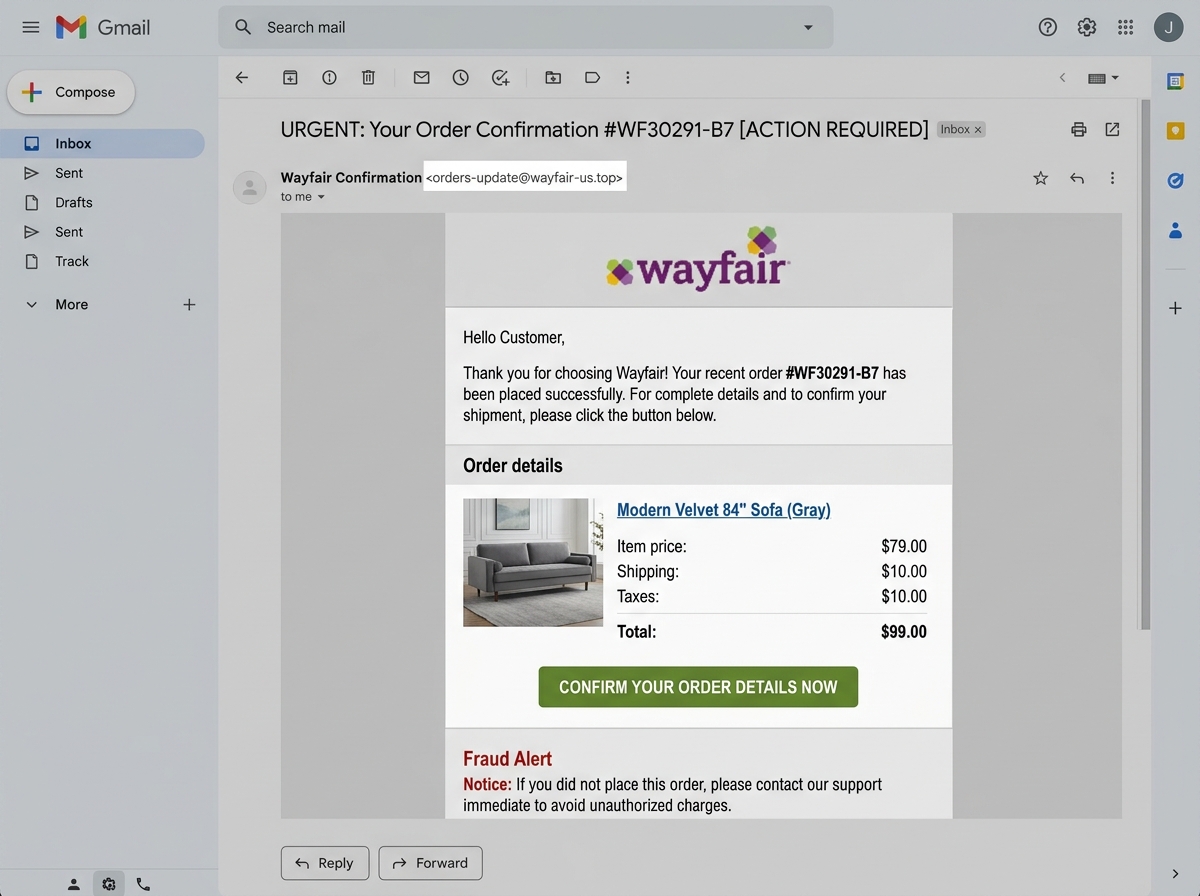
In these cases, the victim sees an ad, clicks through to a site that looks identical to Wayfair, and completes a purchase. The "confirmation" email often comes from a nonsensical address, and the charge on the bank statement is usually listed under a completely different company name, such as "Dingshang Co. LTD."
China-Based Scam Networks
Many of these sites, including the notorious wayfair-us.top, are part of larger, sophisticated networks based in China. These networks operate hundreds of fake retail sites simultaneously. They use a "rinse and repeat" cycle: they launch a site, spend heavily on social media ads, collect thousands of dollars in a few weeks, and then shut the site down once the fraud reports start piling up.
The 90% Off Clearance Wayfair Scam
This is perhaps the most dangerous version because it weaponizes FOMO (Fear Of Missing Out). These scams frequently use slogans like "Warehouse Clearance," "Going Out of Business Sale," or "Today Only."
According to experts at Don't Fall For The Fake Wayfair 90% Off Clearance Sale Scam, the price points are the biggest red flag. They offer items that normally cost thousands of dollars for less than a hundred. For example:
- A $3,000 sectional sofa for $99.
- A $499 rug for $49.
- Rustic farmhouse coffee tables reduced from $350 to $39.
If you place an order, you will either receive nothing at all or a "brushing" item—a cheap pair of sunglasses or a plastic ring—sent just so the scammer has a tracking number to show the credit card company if you dispute the charge.
Phishing and Fake Order Confirmations
Not every wayfair scam starts with an ad. Some start in your inbox. You might receive an email claiming there is an issue with a recent order or that you have "unclaimed rewards" waiting.
A report on JustAnswer detailed a victim who lost $90.95 after interacting with a site that appeared to be Wayfair. The victim used a PayPal-linked debit card, only to realize later that the confirmation email came from a suspicious subdomain. These phishing attempts are designed to harvest your credit card details or your Wayfair account login, which can then be used for further identity theft.
How to Spot a Wayfair Scam: Red Flags and Warning Signs
Spotting a fake is easier when you know where the scammers get lazy. While they can copy a logo perfectly, they struggle with the technical and legal details of a real business.
| Feature | Official Wayfair.com | Scam Site (e.g., wayfair-us.top) |
|---|---|---|
| Domain Name | wayfair.com | wayday-sale.shop, wayfair-outlet.top |
| Prices | Competitive, but realistic | 70% to 90% off everything |
| Contact Info | Working phone, help center, US address | No phone number, "Contact Us" is just a form |
| Social Media | Verified icons with millions of followers | No links to social media or dead icons |
| Domain Age | Registered decades ago | Registered within the last 30–90 days |
| Writing Quality | Professional and consistent | Grammatical errors and weird phrasing |
Similar to the Afterpay Text Scam, these sites often use "mismatched" information. For instance, the footer might claim the company is headquartered in Boston (the real Wayfair's home), but the domain registration data points to a private individual in a different country.
Identifying a Wayfair Scam on Social Media
Social media is the primary hunting ground for these fraudsters. They buy "Sponsored" slots on Facebook, Instagram, and TikTok because these platforms allow them to target people who have recently searched for furniture.
- Facebook/Instagram: Look at the page transparency. If a page was created yesterday and is already running "90% off" ads, it's a scam. Check the comments; if they are turned off or filled with people saying "Scam!" or "Where is my order?", run away.
- TikTok: Scammers use stolen video footage of "unboxing" furniture to make the deal look real. Always check the link in the bio—if it isn't
wayfair.com, it's a trap. - Pressure Tactics: Ads that use countdown timers or phrases like "Only 5 left at this price" are designed to stop you from thinking clearly.
Recovery Steps: What to Do If You’ve Been Scammed
If you’ve already entered your information into a fake site, you need to move fast. Scammers don't just want your $50 for the "sofa"; they want your credit card number for future, larger thefts.
- Contact Your Financial Institution Immediately: This is the most important step. Call the number on the back of your card. Tell them you were a victim of a fraudulent website and request a chargeback.
- Cancel Your Card: If you provided your CVV and expiration date, your card is compromised. Request a new one with a different number.
- Report to Wayfair: Use the official Wayfair Fraud Prevention page to let them know about the fake site. They have legal teams that work to take these domains down.
- File a Government Report: In the US, report the incident to the FTC at
reportfraud.ftc.govand the FBI’s Internet Crime Complaint Center (IC3). - Monitor Your Credit: Much like the Robinhood Alert Text Scam, a retail scam can be the first step in identity theft. Check your statements for small "test" charges.
- Update Passwords: If you used the same password for the scam site as you do for your real Wayfair account (or your email), change it immediately and enable Two-Factor Authentication (2FA).
Frequently Asked Questions about Wayfair Scams
Is the real Wayfair.com a legitimate website?
Yes, the real Wayfair is a legitimate, multi-billion dollar company. However, it’s worth noting that its popularity doesn't mean it has a perfect record. On the Better Business Bureau (BBB), Wayfair holds a 1.68 out of 5-star rating. Most of these complaints are about shipping delays, damaged products, or customer service issues—not "scams." It is a real business, but like any giant retailer, it has its share of logistical headaches.
How can I tell if a Wayfair ad on Facebook is fake?
Check the URL before clicking. If you do click, look at the browser's address bar. If it says anything other than wayfair.com (like wayfair-clearance.cc), close the tab. Also, look for the "Blue Checkmark" on the Facebook page running the ad. Real Wayfair ads come from the verified Wayfair page, not "Home Decor Deals 2024."
Can I get my money back if I bought from a fake Wayfair site?
If you paid via credit card or PayPal, your chances are very high. Credit card companies offer robust fraud protection. PayPal’s Resolution Center is also effective at handling "Item Not Received" disputes. However, if you paid via wire transfer, gift cards, or cryptocurrency, your money is likely gone forever.
Conclusion
The wayfair scam is a reminder that in online shopping, if a deal feels like a miracle, it’s probably a mirage. Scammers are getting better at mimicking the "look and feel" of our favorite brands, but they can't mimic the security and history of a real domain.
At Tempo Mail USA, we believe that privacy is your best defense. Scammers often get your contact info from data leaks or by tracking your browsing habits. By using a temporary email alias when browsing new sites or signing up for "coupons," you create a secure proxy that protects your real identity and primary inbox from phishing attempts.
Stay vigilant, verify every URL, and protect your data. Before you enter your email or credit card on a site that seems just a little too cheap, consider using a layer of protection. Protect your data with a secure temporary email and keep your real information out of the hands of offshore scam networks. Happy (and safe) shopping!
Need a disposable temporary email?
Protect your real inbox from spam and promotional clutter instantly and free.
Received a suspicious email, text, or charge alert?
Verify whether the sender domain is disposable, spoofed, or unverified before clicking links.