
Temp Email for Synthesia Signup: the Free Launch Credits Expired on Nov 9 — What the Basic Plan Still Gives You
The short answer first
Yes, a temp email works for Synthesia signup, as far as the evidence goes. The signup asks for an email address and a password, no credit card is required for the free Basic plan, and a hands-on test published November 7, 2026 signed up a brand-new account with no card added. But the reason to read past this paragraph is not the signup. It is the calendar. Synthesia launched its new AI video agent, Syren, on October 9, 2026, and handed every user 2,000 Syren launch credits to make a first video free. Those credits expired on November 9, 2026. If you are searching for Synthesia this week because you heard the first video is free, that version of the offer is already gone — and what replaced it is smaller, shorter-lived, and harder to spend than the headlines suggested. This post works through what the free plan actually gives you on November 25, 2026, what the two products inside one Synthesia account each allow, and where a disposable inbox helps and where it quietly costs you the workspace.
One honesty note, the same as the rest of this series: I did not create a live Synthesia account for this post, so I am not going to pretend I clicked through the form with a temp inbox myself. What follows is built from the live pricing page I fetched on November 25, 2026, from Synthesia's own Syren launch post of October 9, and from a hands-on free-plan review that tested the signup on November 7. Where the sources disagree — and on the credit allowance they disagree by more than double — I give you both numbers with dates instead of picking the tidier one.
The free video is already gone
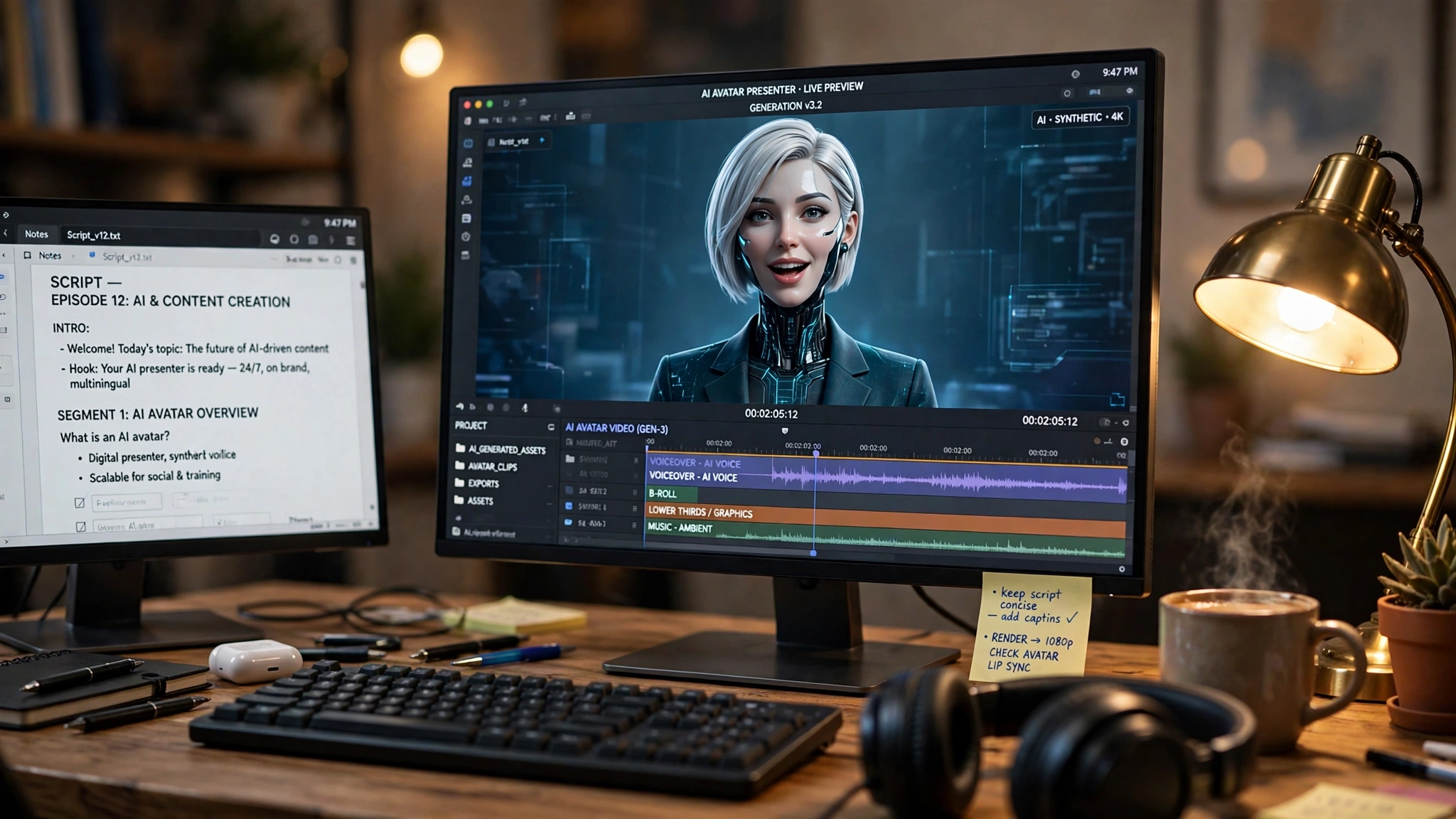
Syren is the reason Synthesia is in the news at all this month, and it is worth understanding what it is before the signup question makes sense. Synthesia's original product is Studio, a scene-by-scene editor where you type a script and an AI avatar reads it. Syren, launched in beta on October 9, 2026, is a different animal: an agent that takes a sentence, a preset, or a document and builds the whole video — motion graphics, avatars, voiceover, music, b-roll — writing the video as code and rendering it live in front of you, then refining it through chat when you ask for changes. Synthesia's own launch post calls it "the editor" rather than an assistant to one, and that is not marketing fluff; the workflow really is prompt-first instead of timeline-first. In the six weeks since launch, Synthesia has also pushed Syren into ChatGPT as a plugin (November 3) and into Claude as a connector (November 16, built on Anthropic's Opus 5.5), which is why the product is suddenly everywhere in AI-tool roundups.
The launch came with a bribe, and the bribe had a deadline. Every user received 2,000 Syren credits to make a first video, and Synthesia's help center put the expiry at November 9, 2026, at 23:59 BST. That date has passed. The live pricing page I fetched on November 25 still lists "1 Syren video — limited promo" on the free Basic plan, and it still shows promo credits — 1,000 on Basic, 1,500 on Starter and Pro — valid for one month and marked "limited time only." So the door did not slam shut entirely. But the generous version is gone, the current promo is half the size, and nobody's headline has caught up: most of the guides ranking for Synthesia this week were written while the 2,000-credit offer was still alive. If you sign up today expecting two thousand free credits, check the promo line on the pricing page first, because the number you were promised expired sixteen days ago.
Two Synthesias live in one account
Here is the part that trips up almost every first-time tester, and the reason the free plan reads so confusingly: you are not signing up for one product. You are signing up for two, and the free rules for each are different.
Studio is the original editor. On Basic you get 10 minutes of Studio video creation or dubbing a month, 9 AI avatars, 140+ languages and voices, and 60+ templates. The catch, confirmed by the November 7 hands-on test, is that Studio videos cannot be downloaded on the free plan — clicking Download asks you to upgrade to Starter — and every video carries the Synthesia watermark. You can build a complete video and preview it, but the file never leaves the platform.
Syren is the new agent, and its free rules run the other way. Syren videos on Basic are capped at 3 minutes, carry the same watermark, and come with a share link — but the same November 7 test downloaded Syren videos as 1080p MP4 files with the watermark, on the free plan, with no upgrade prompt. One guide puts a two-week window on that sharing and downloading on Basic; the hands-on test, which actually did it, does not mention a window. I am reporting both because the discrepancy is real and dated, and the test is the stronger evidence. Either way, the shape is clear: on the free plan, Studio is the product you can preview but not keep, and Syren is the product you can keep but only in short, watermarked form.
The two share one credit pool, which is where the arithmetic gets uncomfortable — that is the next section. But first, the comparison that matters if you are choosing between avatar-video tools: HeyGen is the closest rival in this category, and its signup works with a temp email too, with its own free-tier limits. Sora is the other video name in this series, but it is a different shape entirely — a text-to-video generator whose door closed in April 2026, not an avatar presenter. And if video editing rather than avatars is what you actually need, Descript's signup is the one to compare against Synthesia's Studio side.
The signup, as the sources describe it
The flow the sources agree on is short. Go to the site, enter an email address and a password, and pick the free Basic plan from a plan picker that appears right after signup — the November 7 tester chose Basic there with no card added. Two quick onboarding questions follow (your role, and how you heard about Synthesia), and then you land on a "What do you want to make?" screen. One detail from that test is worth more than the rest of the flow: Synthesia had already pulled the tester's company logo from their email domain and suggested topic prompts based on it. Your email domain is not just an inbox to Synthesia; it is your company identity, read at signup and used to brand your workspace before you have made anything.

Three things in that flow matter for a temp-email reader. First, nothing in the signup pages or the hands-on test suggests disposable domains are blocked at the door — the verification is a standard email check, and the free tier asks for no payment method. I found no evidence of a work-email requirement or a disposable-domain rejection, and I am not going to invent one; if you hit a rejection on a specific temp domain, it is worth trying another domain before concluding the door is closed. Second, the verification code has a shelf life like every other code, so the inbox needs to be alive when the code lands — the expiry windows differ enough across services that it is worth knowing how long verification codes stay valid before you start the clock. Third, reviewers report that the platform only works in Chrome and Edge, a limitation that is not disclosed until after signup — a small thing, but the kind of thing that wastes an afternoon if your default browser is Firefox or Safari.
The credit math moved while nobody was watching
This is the messiest part of the post, and the part where I have to show my work. Synthesia prices everything in credits now — one shared pool for Studio video, Syren, dubbing, and surveys — and the size of the free pool depends on when you looked.
A pricing check from September 11, 2026 put the Basic plan at 1,200 credits a month. A review verified against the pricing page on November 20, 2026 put it at 500 credits a month. The live pricing page I fetched on November 25, 2026 says 500 credits a month. Two of the three sources agree on 500, and the live page is the one that counts, so 500 is the number to plan around — but the cut from 1,200 to 500 happened quietly, with no announcement I could find, and the older figure is still circulating in guides that have not been updated. If a guide tells you the free plan gives you 1,200 credits, check its date; it is describing September's plan, not November's.
Now do the arithmetic the pricing page itself invites. The same live page says a one-minute Syren video typically uses 1,000 to 2,000 credits. Your entire monthly credit allowance on Basic is 500. One minute of Syren costs two to four times everything you get in a month. The reason the free plan still works at all is that the 10 minutes of Studio video a month sit outside the credit pool — they are a separate free allowance, not something you buy with credits. So the honest shape of the free month is this: ten minutes of Studio video you can build but not download, one short Syren video on promo credits, and a 500-credit pool that does not stretch to a single additional Syren minute. Every chat edit in Syren also burns credits, so the "refine it by chatting" loop that makes Syren attractive is the first thing to eat the allowance.
The paid tiers, for the record, are Starter at $19 a month billed monthly or $14 a month billed yearly ($168 a year) with 1,250 credits a month, and Pro at $89 a month or $59 a month billed yearly ($708 a year) with 72,000 credits a year. Starter's yearly credits work out to about 24 Syren videos a year on the page's own figures; Pro's to about 84. The plan names have churned too — September sources called the $89 tier "Creator"; the live page calls it "Pro" — so if a guide quotes Creator pricing, it is describing the same tier under its old name.
The Black Friday clock is running
There is one more date on the live pricing page, and it is the reason this week is the cheapest week to test Synthesia. A Black Friday / Cyber Week offer runs from 16:00 GMT on November 23 to 07:59 GMT on December 7, 2026: Starter at $9 for the first month (then $19), Pro at $49 for the first month (then $89). The terms matter: the offer is available to new customers and to free-plan users upgrading to a paid plan only — not to anyone who already holds a paid Synthesia subscription. At the time I fetched the page, the countdown read six days and twelve hours.
That exclusion shapes the temp-email strategy more than it first appears. If you test on Basic with a disposable inbox and decide to upgrade inside the window, you get the promo price. If you already paid full price on an earlier account, you do not. And if you test with a temp inbox, upgrade, and then lose the inbox, the billing relationship — receipts, failed-payment notices, the cancellation link — all goes to an address that no longer exists. The promo makes this the best week of the year to try the paid tiers, and the worst week to do it from an inbox you cannot keep.
Where the temp inbox helps, and where the workspace eats it
The verification step is the easy part. A temp inbox receives the code, you enter it, you pick Basic, you are in. What a temp email cannot do is hold the account afterwards, and a Synthesia account holds more than most of the tools in this series because Synthesia is built for teams, not individuals. The pricing page leads with "trusted by over 90% of Fortune 100 companies," and the product is shaped accordingly: your account is a workspace with one editor seat, guest invites, and — on paid plans — brand kits, personal avatars (3 on Starter, 5 on Pro), and shared credit pools. Your videos, your brand settings, your survey responses, and your Syren chat history all live in that workspace, and the workspace is anchored to the email you signed up with.

That is the same trap as in every post in this series, but it bites differently here than it did for a video generator you use once. A Synthesia workspace is where a team's training videos and brand assets accumulate; losing access to it is not losing a login, it is losing the library. My rule of thumb, and it has held up across twenty-some tools now: a temp email is for answering a question — "does this tool do what I need?" — and the answer to that question takes an afternoon, not a month. If the afternoon goes well, move the account to a real inbox before you build anything you would miss. The guides for choosing a burner email that actually works cover the middle ground: a stable alias you control, which keeps the spam out of your real inbox without handing your workspace to an address with a ten-minute lifespan.
There is one more consideration specific to Synthesia, and it follows from the logo detail in the signup section. Because the onboarding reads your email domain as your company, a disposable domain does not just hide your identity — it gives the workspace no company to attach to. That is cosmetic on day one and a small tell about how the product thinks about you: you are a company first and a person second. If you are testing as an individual, that is fine. If you are testing for a team, sign up with the domain the team actually uses, because everything downstream — guests, brand kits, shared credits — assumes it.
The five-minute test, Syren edition
If you want to answer the question for yourself, here is the whole test, in order. One, open a temp inbox and keep the tab open — the code has to arrive while the inbox is alive. Two, sign up with the temp address, choose Basic on the plan picker, and answer the two onboarding questions. Three, skip Studio for the first test and go straight to Syren — describe a one-minute video from a document you already have, and watch what the agent builds. Four, download the Syren result while you still can and check the watermark and the length cap against what the pricing page promises. Five, decide before you build anything else: if the agent earns a place in your work, move the account to an inbox you control — and if you want the paid tiers, do it before the Cyber Week offer ends on December 7. The test costs five minutes and one disposable address. The mistake costs a workspace attached to a dead inbox.
FAQ
Can I sign up for Synthesia with a temp email?
As far as the evidence goes, yes. The signup asks for an email address and a password, the free Basic plan needs no credit card, and a hands-on test on November 7, 2026 signed up a new account with no card added. I found no evidence of a disposable-domain block or a work-email requirement. The account you create is a workspace, and everything tied to it — password resets, billing, plan notices — goes to that inbox.
Is Synthesia really free?
The Basic plan is $0, with 500 credits a month, 10 minutes of Studio video a month, 9 avatars, and Syren videos up to 3 minutes. The limits are real: Studio videos cannot be downloaded on the free plan, every video carries the Synthesia watermark, and the 500-credit pool does not cover a single additional minute of Syren, which typically costs 1,000 to 2,000 credits a minute.
What happened to the free Syren launch credits?
Synthesia gave every user 2,000 Syren launch credits when Syren launched in beta on October 9, 2026. Those credits expired on November 9, 2026, at 23:59 BST. The live pricing page now shows a smaller promo — 1,000 credits on Basic, valid for one month, marked "limited time only."
How many credits does a Syren video use?
According to the live pricing page, a one-minute Syren video typically uses 1,000 to 2,000 credits, and every round of chat edits costs credits too. Starter adds 1,250 credits a month; Pro adds 72,000 credits a year.
Can I download videos on the free plan?
Syren videos, yes — a hands-on test on November 7, 2026 downloaded them as 1080p MP4 files with a watermark on the free plan. Studio videos, no — the Download button on the free plan asks you to upgrade to Starter. One guide mentions a two-week window for sharing and downloading on Basic; the hands-on test does not.
Is Synthesia the same as HeyGen?
No, but they are the closest rivals in the AI-avatar-video category: both turn scripts into presenter-led videos. HeyGen's signup works with a temp email too, and its free tier has its own limits — the two are worth testing side by side on the same afternoon with the same throwaway inbox.
The verdict
Synthesia is the most interesting temp-email test in this series so far, not because the signup is hard — it is not — but because the thing you are signing up for is two products with two different free rules, a credit allowance that was quietly cut from 1,200 to 500, and a launch offer that expired sixteen days before you read this. The email door opens. The free month behind it is ten Studio minutes you can build but not download, one short Syren video you can keep, and a credit pool too small for a second Syren minute. Test it with a temp inbox for an afternoon, the way the tool deserves to be tested — with a real document, through Syren, not the demo — and if it earns a place in your work, give it a real email before you build anything you would miss. A disposable inbox is a fine way to ask a question. It is a bad place to keep the answer.
Need a disposable temporary email?
Protect your real inbox from spam and promotional clutter instantly and free.
Received a suspicious email, text, or charge alert?
Verify whether the sender domain is disposable, spoofed, or unverified before clicking links.